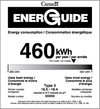
EnerGuide for Appliances
Natural Resources Canada - Office of Energy Efficiency
Canada's official energy label helping consumers compare appliance efficiency
The EnerGuide for Appliances costs $0 USD. Renewal costs $0 USD.
Key Strengths
- Mandatory federal program ensuring universal market compliance in Canada
- Standardized energy consumption labeling enables direct consumer comparison
- Backed by Canada's Energy Efficiency Regulations — legally enforceable
- Covers a wide range of household appliances (refrigerators, washers, dryers, dishwashers)
- Administered by a trusted federal government body (Natural Resources Canada)
- Helps manufacturers demonstrate regulatory compliance and product credibility
Ideal For
EnerGuide for Appliances is best suited for manufacturers and importers of household appliances who sell products in the Canadian market and must comply with federal energy efficiency regulations. It is also highly relevant to product compliance managers, regulatory affairs professionals, and energy engineers working within consumer appliance companies operating in Canada.
Target Audiences
Relevant Roles
Industries
Alignment & Recognition
Accrediting Body
Product Categories
Overview
EnerGuide for Appliances is a mandatory labeling program administered by Natural Resources Canada's Office of Energy Efficiency. The EnerGuide label appears on household appliances sold in Canada and displays how much energy a model consumes over a year of typical use, measured in kilowatt-hours. This allows consumers to directly compare the energy consumption of different models within the same size and product category before making a purchase.
The program is backed by Canada's Energy Efficiency Regulations, which set minimum energy performance standards that appliances must meet in order to be sold in the Canadian market. The EnerGuide label serves as confirmation that a product complies with these mandatory requirements, giving consumers a reliable, standardized basis for evaluating energy use across brands and models.
EnerGuide for Appliances is relevant to manufacturers and importers of household appliances — such as refrigerators, dishwashers, washing machines, and dryers — who sell products in Canada. Compliance is not optional; carrying the label is a regulatory requirement under federal law. For consumers, the label is a practical tool for identifying more energy-efficient products that can reduce electricity costs and environmental impact over the lifetime of the appliance.
Requirements & Verification
Evidence Requirements
Conformity with EnerGuide for Appliances's standard is verified by an independent organization (third party).
Prerequisites
Assessment Process
Manufacturers and importers must submit product energy performance test data conducted by accredited third-party laboratories in accordance with prescribed test methods under Canada's Energy Efficiency Regulations. Natural Resources Canada reviews submitted documentation to verify that products meet minimum energy performance standards before the EnerGuide label may be affixed. There is no on-site audit of the manufacturer; compliance is verified through laboratory test reports and regulatory filings.
Renewal & Compliance
Compliance with EnerGuide for Appliances is an ongoing regulatory obligation under Canada's Energy Efficiency Regulations. Manufacturers and importers must ensure that all new models placed on the Canadian market continue to meet current minimum energy performance standards and carry the updated EnerGuide label. As regulations are periodically updated by Natural Resources Canada, companies must re-test and re-label products when standards change or new model variants are introduced.
Accountability Model
Consider Alternatives If...
If you are a manufacturer selling exclusively outside Canada, this program is not applicable to your products. Companies seeking a voluntary, market-differentiating eco-label rather than a mandatory regulatory compliance label should consider ENERGY STAR or similar programs instead.
Alternative Programs
How to Get StartedAI-synthesized
- Determine applicability: Confirm that your product falls within the scope of Canada's Energy Efficiency Regulations (e.g., refrigerators, dishwashers, washing machines, dryers, freezers, room air conditioners).\n2. Identify the applicable test standard: Consult Natural Resources Canada's Energy Efficiency Regulations to identify the prescribed test method for your product category (typically CSA or ISO-based standards).\n3. Engage an accredited laboratory: Contract an accredited third-party testing laboratory to conduct energy performance testing on your product model(s) in accordance with the prescribed test method.\n4. Compile test documentation: Gather laboratory test reports, product specifications, and any other documentation required under the Energy Efficiency Regulations for your product category.\n5. Register and file with Natural Resources Canada: Submit a Declaration of Compliance and required test data to Natural Resources Canada's Office of Energy Efficiency through the Energy Efficiency Regulations compliance process.\n6. Generate the EnerGuide label: Once compliance is confirmed, produce the EnerGuide label displaying the model's annual energy consumption (kWh/year) and affix it to all units sold in Canada.\n7. Monitor regulatory updates: Track amendments to the Energy Efficiency Regulations and re-test or re-label products as standards are updated or new model variants are introduced.
Testing & Evaluation CriteriaAI-synthesized
The EnerGuide for Appliances program evaluates the energy performance of household appliances against prescribed test methods and minimum energy performance standards (MEPS) set out in Canada's Energy Efficiency Regulations. Testing is conducted by accredited third-party laboratories using standardized protocols — typically aligned with CSA Group or ISO test standards specific to each product category.\n\nFor each product category, the key metric assessed is annual energy consumption, measured in kilowatt-hours (kWh) per year under simulated typical-use conditions. For example, refrigerators and freezers are tested over a defined cycle at specified ambient temperatures; washing machines are assessed on water and energy use per cycle; dishwashers are evaluated on energy and water consumption per wash cycle. The resulting figure is what appears on the EnerGuide label.\n\nProducts must meet or exceed the applicable Minimum Energy Performance Standard (MEPS) for their category and size class before they are legally permitted to carry the EnerGuide label and be sold in Canada. Natural Resources Canada reviews submitted test reports and Declarations of Compliance to verify that the product's measured energy consumption falls within the regulatory threshold. There is no scoring system or tiered rating — compliance is binary: a product either meets the standard or it does not.
Market Context & AdoptionAI-synthesized
EnerGuide for Appliances is one of Canada's longest-running and most universally recognized consumer energy programs, having been in operation since 1978. As a mandatory federal labeling requirement under the Energy Efficiency Act and associated regulations, it has near-universal market penetration among major household appliance categories sold in Canada. Every major appliance manufacturer or importer operating in the Canadian market — including global brands such as Whirlpool, LG, Samsung, GE Appliances, and Bosch — must comply with the program.\n\nThe program is widely respected for its standardized, government-backed methodology, which gives consumers a reliable basis for comparing energy consumption across brands and models. It is often used in conjunction with the voluntary ENERGY STAR program (also administered in Canada by Natural Resources Canada), where EnerGuide provides the baseline compliance label and ENERGY STAR identifies top-performing products. This complementary relationship means EnerGuide is seen as the regulatory floor, while ENERGY STAR represents the market-differentiating ceiling.\n\nDemand for energy efficiency labeling in Canada remains strong, driven by federal and provincial climate commitments, rising electricity costs, and growing consumer awareness of environmental impact. Natural Resources Canada periodically tightens the MEPS under the Energy Efficiency Regulations, which has the effect of progressively raising the bar for all products in the market. The program faces no significant competitive threat domestically, as it is legally mandated, though it is often compared internationally to the EU Energy Label, Australia's Energy Rating Label, and the U.S. EnergyGuide label — all of which serve similar regulatory functions in their respective markets.
History & EvolutionAI-synthesized
The EnerGuide for Appliances program was established in 1978 by Natural Resources Canada's Office of Energy Efficiency, making it one of the earliest mandatory appliance energy labeling programs in the world. It was created in response to the energy crises of the 1970s, with the goal of helping Canadian consumers make more informed purchasing decisions and reducing national energy consumption. The program was formalized under the Energy Efficiency Act (1992) and the associated Energy Efficiency Regulations, which gave it legal force as a mandatory requirement for manufacturers and importers.\n\nOver the decades, the program has expanded its scope to cover an increasing range of household appliances and has undergone multiple revisions to its test methods and minimum energy performance standards, reflecting advances in appliance technology and Canada's evolving climate policy commitments. The EnerGuide label itself has been redesigned periodically to improve consumer readability — most notably with a significant label redesign in the 2010s that updated the visual format and added contextual information to help consumers understand how a product compares to similar models. The program continues to be administered by Natural Resources Canada and remains a cornerstone of Canada's federal energy efficiency policy framework.
Frequently Asked Questions
Quick Facts
Certification
English, French
1978
Cost Breakdown
How to Use This Label
Certification Details
Assessment
Verification
Structure
Governance
Fee Structure
Related Certifications

EPEAT Climate+ Champions
Global Electronics Council® (GEC)

Global Green Tag certification Personal Products
Global GreenTag

CertiPUR-US
Alliance for Flexible Polyurethane Foam, Inc
KCMA Certified Quality Tested Cabinet
Kitchen Cabinet Manufacturers Association (KCMA)

Cradle-to-Cradle Certified Platinum
Cradle to Cradle Products Innovation Institute Inc
Cradle-to-Cradle Certified Gold
Cradle to Cradle Products Innovation Institute Inc
Sources & Citations
Content on this page is AI-enriched from primary sources.
Program WebsiteNatural Resources Canada - Office of Energy EfficiencyLast verified Jun 5, 2026